By Dr Wesa Chau, Executive Director
Yesterday I listened to Violet Roumeliotis AM and Dr Martin Parkinson speak at the National Press Club about skills shortages, productivity, and the persistent underutilisation of migrant skills in Australia. Their discussion highlights a fundamental contradiction in Australia’s labour market: at a time of acute workforce shortages and slowing productivity growth, we are failing to make effective use of the skills already within our borders. This is not simply an issue of fairness or social inclusion—it is a structural economic failure.
This reality is not surprising to me. Having worked with migrants, refugees, and international students for over 25 years, I have seen countless examples of people who are highly capable, qualified, and motivated, yet unable to secure employment commensurate with their skills. Too often, opportunities are denied because of an accent, a lack of so‑called “Australian experience”, or unfamiliar qualifications—barriers that are cultural and systemic rather than reflective of actual competence.
The scale of the problem is evident in the clean energy transition. Per Capita’s report, Charged Up: Strategies for Addressing the Skills Shortage in Electrical Trades for the Clean Energy Transition, estimates that Australia will face a shortfall of nearly 100,000 electricians by 2050. This looming gap threatens our ability to meet emissions targets and deliver critical infrastructure. Yet, despite this shortage, there are currently around 1,300 migrant electricians in Australia who are unable to work in their trade. This stark mismatch reflects systemic barriers to skills recognition rather than an absence of capability.
As Dr Martin Parkinson highlighted, nearly half of all permanent migrants over the past 15 years are employed below their skill level. This includes an estimated 20,000 teachers and 40,000 engineers whose training and experience are not being effectively utilised. These are skilled professionals working below their capacity at a time when Australia faces shortages in education, infrastructure, health, and technology. The productivity cost of this mismatch compounds year after year.
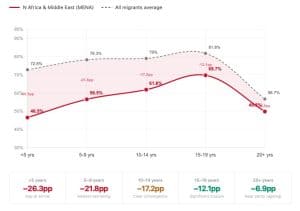
Our own labour force research (see graph below) illustrates how deeply embedded this issue is. Migrants from North Africa and the Middle East experience the largest employment gap of any migrant group—26 percentage points below the migrant average upon arrival. Alarmingly, it takes between 15 and 19 years for this gap to close. This long trajectory makes clear that migrants are not lacking motivation or willingness to contribute. Instead, the delay points to institutional failures: complex accreditation processes, insufficient or expensive recognition of prior learning, limited access to occupation‑specific language training, and poorly coordinated settlement services.
The economic consequences of these failures are substantial. According to Deloitte Access Economics, if migrant skills were fully utilised, Australia could gain an additional $9 billion per year in economic output and create 44,000 new jobs. Our analysis suggests that when the economic contributions of migrants take nearly two decades to fully materialise, the opportunity cost is immense. Over a 15‑year period, Australia may be foregoing at least $135 billion in potential economic value—losses that our economy cannot afford when our population is ageing with rising fiscal pressures.
This evidence points to a clear conclusion: Australia needs stronger and effective policy intervention. Investment in effective settlement services, targeted English‑language programs, and streamlined recognition of prior learning must be treated as economic infrastructure, not discretionary social spending. Faster pathways into skilled employment would boost productivity, reduce labour shortages, and improve long‑term fiscal outcomes. Failing to act does not save costs—it simply postpones them, at a much higher price to Australia’s economic future.