

By Osmond Chiu, Research Fellow
Over the past year, a chart by The Economist from April 2025 has gone viral – circulating heavily on LinkedIn and cited by conservative thinktanks and parliamentarians to argue that Australia has a “bloated” government. The chart claims that, adjusted for population, Australia has 143 public sector employees per 1,000 people or about 29% of all workers, placing it among the largest public sector workforces in the world.

If that sounds surprisingly high, that’s because it is. The source of this figure, the International Labour Organisation (ILO), is an outlier. The truth is far more complicated, and the numbers from other reputable sources tell a very different story.
What the OECD and ABS Actually Say
A more accurate global picture comes from the Organisation for Economic Co-operation and Development (OECD) which found that only 2,257,700 people, or 15.7% of the workforce, were employed in all levels of government (federal, state and local), below the OECD average of 18.4%. That’s roughly 85 public sector employees per 1,000 people.
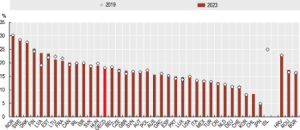
The OECD data aligns with domestic data on the public sector workforce. The most recent Australian Bureau of Statistics (ABS) data (June 2025) puts Australia’s entire public sector workforce at 2,597,300, out of a total labour force of 14,637,800 or just 17.7% of the workforce.
These two sources suggest that the ILO figures are not accurately showing the size of the public sector workforce in Australia.
So What’s Going On With The Economist’s Chart?
The issue lies in the definition used by ILO, which was not properly explained in The Economist’s chart. The ILO defines the public sector as:
- All government institutions
- State-owned enterprises (50%+ government ownership)
- Government-controlled non-profit institutions.
The ILO states it may be difficult to accurately capture public sector employment for persons in non-profit institutions controlled and/or mainly financed by governments. It will depend on the individual’s perception of the institutional affiliation or nature of their work.
What seems to have happened is this broad definition has ended up capturing the entire ‘non-market’ sector, not just government employment. It includes sectors that receive significant taxpayer funding but are not government-run such as disability care, early childhood education, and private education.
Understanding the ‘Non-Market’ Sector
According to the ABS, the non-market sector includes:
- Public Administration and Safety
- Education and Training
- Health Care and Social Assistance
- Ownership of Dwellings (excluded from employment figures)
While 90% of public sector jobs are in these industries, there are also many private sector jobs in them. For example, in Health Care and Social Assistance, 75.1% of jobs in September 2024 were in the private sector.
The ABS estimates that the ‘non-market’ sector accounts for 31% of the workforce, close to the ILO figure used by The Economist. Using the ‘non-market’ sector as a proxy for the public sector is problematic. Using it as a fig leaf to exaggerate the size of the Australian public sector is downright misleading and driven by politics.
The Austerity Politics of “Taxpayer-Funded Jobs”
The phrase “taxpayer-funded jobs” to refer to ‘non-market’ sector jobs has become a favourite talking point for the Coalition and business groups opposing the Albanese Government, framing increased investment in ‘non-market’ services as government “bloat”. It’s a slippery term that deliberately blurs the line between public sector roles and private providers delivering publicly funded services.
What critics are really objecting to is growth in the care economy, they are objecting to more disability care workers, more aged care staff, and more early childhood educators.
This reinforces a critical point: definitions matter. Misusing broad data to push political narratives does not just mislead the public, it clearly is aimed at laying the political groundwork for austerity measures that threaten the very services our communities rely on.