

By Dr Wesa Chau, Executive Director
“Everyone gets a fair go” is one of Australia’s most cherished values. We often pride ourselves on being a country where diversity is a strength and where anyone — with enough passion, hard work and persistence — can rise to leadership. But The Way In, Per Capita’s latest analysis of the 48th Parliament, reveals a more complicated truth. While we have taken meaningful steps forward, the pathways into federal politics remain narrow, elite, and far from reflective of the nation our parliamentarians are elected to serve.
Before diving into the findings, I’m reminded of a moment that crystallised the power of assumptions. When I was invited to speak at a leadership conference, I arrived at a venue hosting two events: one on leadership and the other on childcare. Other participants were asked which event they were attending – I wasn’t, staff directed me straight to childcare. It showed how assumptions about who looks like a leader still shape how people are seen and treated.
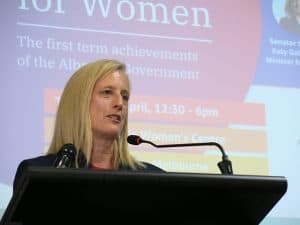
Let’s begin with the progress. Gender parity is no longer a distant aspiration — it’s a reality. Women now make up 49.6% of federal parliamentarians, the closest to equality we have ever been. Thanks in large part to the Labor Party’s affirmative action rules, the Federal Cabinet is majority female for the first time in history at 52.2%. This matters. With more women in leadership, governments become more responsive to issues such as health, education, safety and equity. It also shows young Australians that leadership is not defined by gender.
But we cannot assume the job is done. Progress like this is the result of structural mechanisms that keep pressure on the system. Remove those mechanisms and progress can be undone overnight. It’s worth remembering that just 11 years ago, Australia had a male Minister for Women — a reminder that representation can move backwards if not protected.
First Nations representation is another important area of progress — though not without its complexities. Nine Aboriginal and Torres Strait Islander parliamentarians now sit in the Federal Parliament, around 4% of all members, which is above population share. However, numbers alone do not guarantee influence. Without collective mechanisms, the ability of First Nations parliamentarians to shape outcomes depends heavily on party structure and political alignment.
Cultural diversity presents perhaps the most uneven story. Australia is one of the most culturally diverse nations on earth, and Parliament is slowly beginning to reflect that reality. There is less dominance of Anglo-Celtic backgrounds, and we are seeing more representation from a mix of cultural communities. Yet gaps remain stark. Large and longstanding communities — especially Chinese and Indian Australians — are significantly under-represented in federal politics. This disconnect matters. When major communities do not see themselves reflected in Parliament, their concerns, lived experiences and policy priorities can be overlooked.
Another key gap highlighted is the representation of overseas-born Australians. Almost a third of Australians (29.3%) were born overseas, yet only 12.8% of MPs and Senators share that experience.
Age representation adds a further layer of imbalance. Our Parliament is dominated by Generation X and Baby Boomers. Millennials — now the largest share of the working-age population — are under-represented. The only Gen Z sitting in the 48th Parliament is from the Australian Labor Party. The median age of parliamentarians is roughly a decade older than the median age of voters. This is not about pitting youth against experience; it is about perspective. Younger Australians face distinct challenges: climate anxiety, housing affordability, HECS debt and insecure work. When their voices are missing from the decision making table, these issues risk being misunderstood or deprioritised.

Educational and professional pathways into Parliament deepen this disconnection. Nearly one in three parliamentarians holds a postgraduate degree — compared with just 6.5% of Australians. Parliament is overwhelmingly university-educated, with backgrounds concentrated in law, politics, business and economics.
Perhaps the most striking finding from The Way In is the narrowing of political pathways. Politics has increasingly become a profession accessed through only a handful of routes: political staffer, union official, business executive or lawyer. When the pathways into leadership narrow, so too does the diversity of thinking and experience within our democracy.
These findings have profound implications. Representation is not symbolic — it shapes trust, legitimacy and the quality of democracy itself. When Parliament does not look like the people it represents, it risks not legislating for them. According to the 2025 McKinnon Index, trust in federal politicians is just 35.9%, and trust in political parties is even lower at 31.2%. Strengthening representational diversity is not only about fairness — it is essential for rebuilding trust.
Australia has changed. Our Parliament must keep up.
The Way In shows that while we are on the right track in some areas, we remain deeply constrained in others. If we want a Parliament that genuinely reflects the people it serves, we must broaden the pathways, dismantle the barriers and open the doors to a wider range of Australians.
A democracy is strongest not when power is held by the few who have always had access, but when it is shared by the many who have always belonged.